
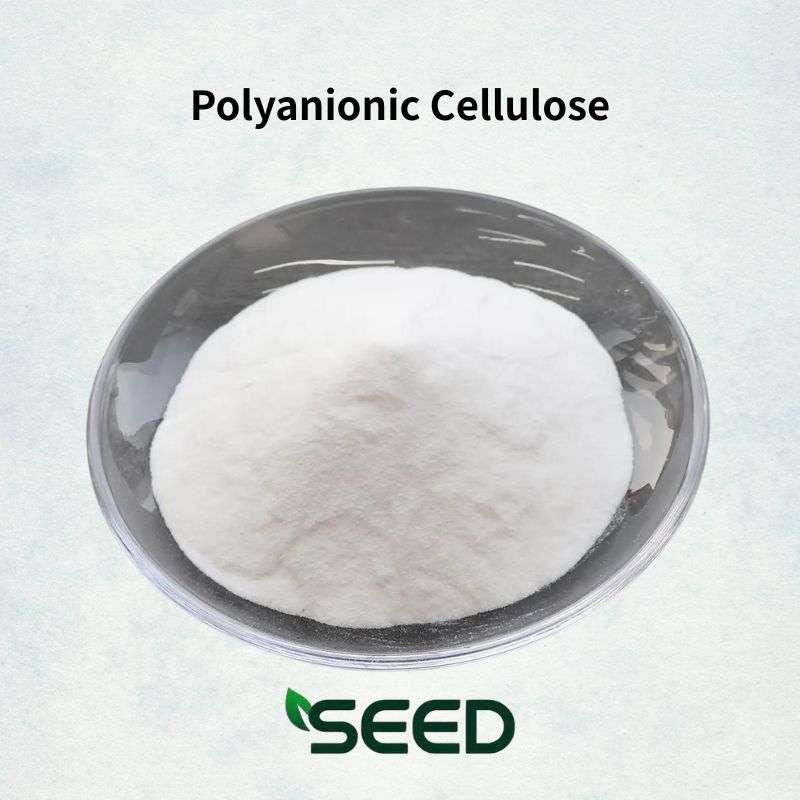
Polyanionic Cellulose
SEED PAC Product Details
PAC is a water-soluble cellulose derivative primarily used in oil and gas drilling operations as rheology modifier and fluid loss control agent. It provides excellent viscosity control, shale stabilization, and filtration control in drilling fluids across diverse geological conditions.
- Chemical Name: Polyanionic Cellulose
- Alternative Name: Poly(Carboxymethyl Cellulose) – High DS Grade
- Appearance: White to cream-colored free-flowing powder
- Particle Size: 90% min. passing through 100 mesh
- Bulk Density: 0.50-0.70 g/cm³
- pH Value: 7.0-9.0 (1% aqueous solution)
- Degree of Substitution (DS): 0.8-1.2
- Moisture Content: ≤10%
- Purity: ≥95%
SEED PAC Product Parameters
PAC Viscosity Grades Available:
Low viscosity (LV): <30 mPa·s Regular viscosity (RV): 30-60 mPa·s High viscosity (HV): >60 mPa·s
(Measured as 2% solution in 2% KCl at 25°C using Brookfield viscometer)
PAC Solubility:
Readily soluble in fresh water and brine
Excellent salt tolerance (up to saturation levels)
Forms clear to slightly hazy viscous solutions
Stable in high-salinity environments
Other:
Thermal Stability: Maintains performance up to 150°C
Storage Conditions: Store in dry, cool place. Keep away from moisture. Shelf life: 24 months in sealed packaging.
Packaging: 25kg multi-wall kraft paper bags with moisture barrier liner. Palletized for safe transport.
Quality Standards: Complies with API (American Petroleum Institute) specifications for drilling fluid additives.

SEED PAC Product Advantages
Exceptional Salt Tolerance
SEED PAC’s defining characteristic is unmatched salt tolerance, maintains viscosity in saturated salt solutions, performs in high-salinity formations (>200,000 ppm TDS), is resistant to calcium and magnesium contamination, is superior to regular CMC in brines, and enables formulation of high-density salt-based fluids.
Superior Thermal Stability
PAC withstands elevated temperatures, stable up to 150°C (300°F), maintains rheological properties at high bottomhole temperatures, resists thermal degradation better than standard cellulose ethers, suitable for deep well drilling and long-term stability in hot formations.
Excellent Fluid Loss Control
PAC provides outstanding fluid loss reduction, low API fluid loss values (typically <10-15 mL), minimal filtrate invasion into formation, reduced formation damage, maintains wellbore stability, improves cake quality and properties.
Superior Rheology Control
Provides excellent viscosity and gel strength, low shear rate viscosity (LSRV) for cuttings suspension, appropriate flow properties for drilling efficiency, flat rheological profile (low plastic viscosity, appropriate yield point), minimal impact on equivalent circulating density (ECD), improved hole cleaning.
Shale Stabilization
PAC helps stabilize reactive shale formations, reduces shale hydration and swelling, inhibits clay dispersion, minimizes wellbore instability, reduces stuck pipe incidents, improves wellbore gauge.
Compatibility
Excellent compatibility with drilling fluid additives, compatible with barite and other weighting agents, works with various pH control agents, compatible with biocides and corrosion inhibitors, stable with lost circulation materials, integrates well in complex fluid systems.
SEED PAC Product Application




SEED PAC Frequently Asked Questions
How does PAC function in laundry detergent and hand soap formulations?
PAC serves as an effective thickener, stabilizer, and anti-redeposition agent in liquid laundry detergents and hand soap products, enhancing cleaning performance and product quality. In laundry detergents, the polymer builds appropriate viscosity for controlled pouring and accurate dosing while maintaining excellent flow characteristics through dispensing systems. PAC provides crucial anti-redeposition properties, preventing soil particles removed from fabrics during washing from reattaching to clean clothes, which is especially important for maintaining brightness and preventing graying of white fabrics over repeated wash cycles. In hand soaps, PAC creates rich texture, enhances foam stability and quality, improves skin feel, and is biodegradable meeting environmental sustainability requirements increasingly demanded by consumers and regulations worldwide.
What benefits does PAC provide in toothpaste formulations?
PAC functions as a binder, thickener, and stabilizer in toothpaste formulations, providing the characteristic texture, stability, and performance consumers expect from quality oral care products. The polymer creates appropriate viscosity so toothpaste dispenses smoothly from tubes, maintains its ribbon shape on the toothbrush without running or collapsing, and provides pleasant consistency during brushing. PAC effectively binds and suspends abrasive particles like silica, calcium carbonate, or dicalcium phosphate evenly throughout the formulation, preventing separation or settling during storage and ensuring consistent cleaning performance throughout the product’s shelf life. It stabilizes fluoride and other active ingredients maintaining their efficacy, controls moisture balance preventing the paste from drying out or becoming too fluid, and provides compatibility with flavoring agents, sweeteners, and foaming surfactants.
How is PAC used in printing and dyeing textile applications?
PAC plays important roles in textile printing and dyeing processes, serving as a thickener in print pastes and a protective colloid that improves dye application and color quality. In textile printing, the polymer thickens dye pastes to appropriate consistency for screen printing, roller printing, or digital printing applications, ensuring precise pattern definition and preventing dye bleeding or spreading beyond intended areas. PAC provides excellent pseudoplastic flow behavior where the paste flows smoothly during application but maintains viscosity on fabric preventing pattern distortion. The polymer shows good compatibility with various dye classes including reactive, disperse, acid, and vat dyes commonly used in textile coloration. It improves color yield and brightness by optimizing dye distribution and fixation on fibers, provides good wash-out properties removing easily after dyeing or printing without leaving residues, and helps achieve sharp, vibrant prints with excellent color fastness.
What role does PAC play in textile sizing and finishing operations?
PAC functions effectively in textile sizing operations, providing temporary stiffness and protection to yarns during weaving while being easily removable in subsequent processing. As a sizing agent, the polymer forms protective films on yarn surfaces that reduce friction during weaving, prevent fiber breakage, and minimize shedding of lint that could damage looms or create quality issues. PAC improves yarn strength and abrasion resistance during the demanding mechanical stresses of weaving operations, particularly valuable for delicate or fine yarns prone to breakage. The polymer shows excellent adhesion to various fiber types, penetrates yarn structure evenly, and creates flexible films that don’t crack or flake during weaving movements. It dissolves readily in water during desizing processes, allowing complete removal without harsh chemicals or excessive water consumption, which supports environmental sustainability.
How does PAC function as a fluid loss control agent in oil drilling?
PAC serves as a critical fluid loss control additive in water-based drilling fluids, reducing the filtration of drilling mud into permeable formations and maintaining wellbore stability during drilling operations. The polymer adsorbs onto clay particles and formation surfaces, helping create a thin, low-permeability filter cake on the wellbore wall that effectively blocks pores and prevents excessive fluid invasion into surrounding rock formations. This fluid loss control is essential for maintaining proper mud properties, preventing formation damage that could reduce oil or gas production, and avoiding differential sticking where the drill pipe becomes stuck against the wellbore wall due to pressure differences. PAC provides excellent performance across a wide range of salinity conditions from freshwater to saturated salt muds, maintains effectiveness at elevated temperatures encountered in deep wells, and shows good compatibility with other drilling fluid additives including barite, bentonite, and various polymers.
What advantages does PAC offer for drilling fluid rheology and stability?
PAC provides valuable rheology modification and stability enhancement in drilling fluids, improving their performance characteristics and reliability under demanding downhole conditions. The polymer increases viscosity and gel strength of drilling muds, helping suspend drill cuttings and weighting materials like barite, preventing settling when circulation stops, and ensuring efficient transport of cuttings to surface. PAC provides shear-thinning behavior where the fluid flows easily through drill pipe and pumps under high shear but develops viscosity in the annulus for effective cuttings removal and hole cleaning. It provides thermal stability withstanding elevated bottomhole temperatures, enhances mud stability preventing flocculation and separation of components, improves lubricity reducing torque and drag on drill string, and works synergistically with bentonite clay optimizing overall mud system performance for safe, efficient drilling operations across various geological formations and well conditions.
Products you may be interested in


Connect with Us Today
Reach out to discover how our cellulose ether products can elevate your business and meet all your chemical solution needs.