
Carboxymethyl Cellulose

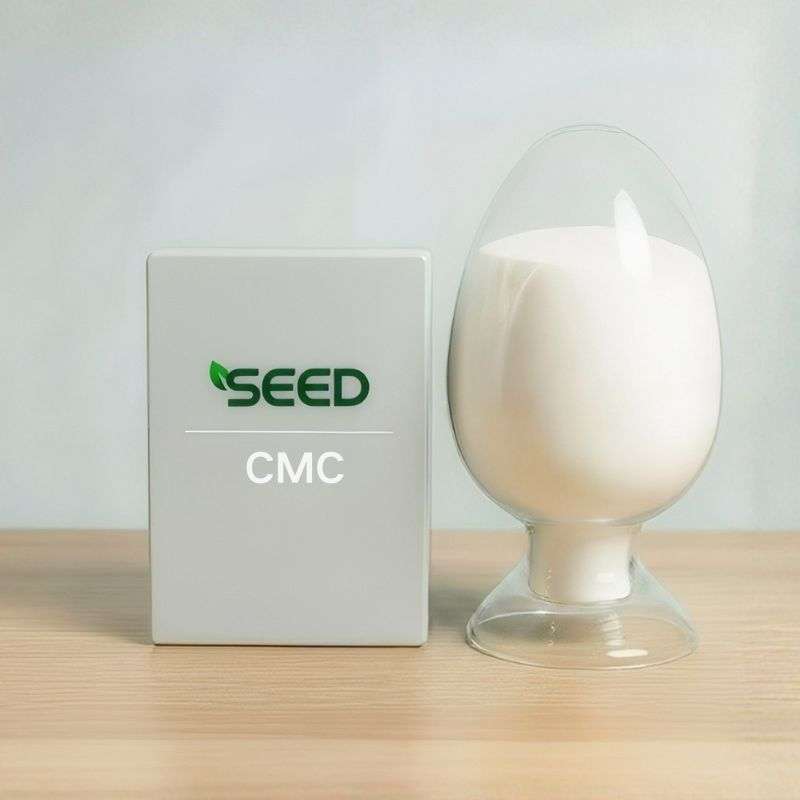
SEED CMC Product Details
CMC is one of the most widely used cellulose derivatives, offering excellent thickening, stabilizing, and water-binding properties across food, personal care, and industrial applications. It enhances texture and stability in beverages and processed foods, improves detergent performance, provides superior rheology control in coatings and adhesives.
- Chemical Name: Carboxymethyl Cellulose Sodium Salt (Sodium CMC, Na-CMC)
- CAS Number: 9004-32-4
- Molecular Formula: [C6H7O2(OH)x(OCH2COONa)y]n
- Appearance: White to cream-colored odorless powder or granules
- Particle Size: 98% min. passing through 80 mesh (standard); various mesh sizes available
- Bulk Density: 0.50-0.70 g/cm³
- pH Value: 6.5-8.5 (1% aqueous solution)
- Moisture Content: ≤10% (standard grade); ≤8% (premium grade)
- Degree of Substitution (DS): 0.65-0.95 (typical commercial range)
- Purity: 99.5% min. (on dry basis for high-purity grades)
SEED CMC Product Parameters
CMC Viscosity Grades Available:
Extra low viscosity: 5-50 mPa·s
Low viscosity: 50-200 mPa·s
Medium viscosity: 200-800 mPa·s
High viscosity: 800-2,000 mPa·s
Extra high viscosity: 2,000-5,000+ mPa·s
(Measured as 2% or 1% aqueous solution at 25°C using Brookfield viscometer)
CMC Solubility:
Readily soluble in cold and hot water
Forms clear to slightly turbid viscous solutions
Insoluble in most organic solvents (ethanol, acetone, ether)
Soluble in some water-miscible solvents (glycerin, ethylene glycol)
Other:
Storage Conditions: Store in cool, dry place. Keep containers sealed. Protect from moisture. Shelf life: 24-36 months under proper storage.
Standard: 25kg multi-wall kraft paper bags with PE liner
Food grade: Special moisture-barrier packaging
Bulk: 500kg-1000kg big bags available

SEED CMC Product Advantages
Excellent Thickening Efficiency
CMC provides superior thickening at low concentrations, high viscosity development at 0.5-2.0% dosage, cost-effective compared to many alternatives, pseudoplastic (shear-thinning) flow behavior, viscosity stable across moderate temperature ranges, wide viscosity range for application flexibility.
Superior Water-Binding Capacity
CMC has exceptional water retention, binds large amounts of water (up to 50 times its weight), prevents syneresis in food and industrial products, maintains moisture in various applications, reduces drying and cracking in construction materials, improves hydration efficiency.
Excellent Suspending Properties
Prevents particle settling and separation, suspends solids and immiscible liquids, prevents pigment settling in paints, maintains uniform dispersions, reduces sedimentation in beverages and emulsions, creates stable suspensions.
Film-Forming Capability
Forms flexible, transparent films, good tensile strength, moisture resistance (moderate), protective barrier properties, adhesion to various substrates, useful in coatings and packaging.
Wide pH Stability
Stable across pH 5-10, suitable for acidic, neutral, and alkaline formulations, maintains viscosity across pH range, compatible with various buffering systems, degrades in strong acids (pH <3) or bases (pH >11).
Anionic Nature Benefits
The anionic character provides, excellent compatibility with anionic surfactants, soil anti-redeposition properties in detergents, electrostatic stabilization of particles, binding to positively charged surfaces, interaction with cationic materials for specialized applications.
Excellent Emulsion Stabilization
Stabilizes oil-in-water emulsions, increases viscosity of continuous phase, reduces coalescence, improves long-term stability, prevents phase separation, enhances texture and mouthfeel.










SEED CMC Frequently Asked Questions
How does CMC improve gluten-free bread quality?
CMC significantly enhances gluten-free bread formulations by mimicking the structural and functional properties normally provided by gluten proteins in traditional wheat-based breads. The polymer creates a network within the dough that effectively traps carbon dioxide gas produced during fermentation, resulting in improved volume, better rise, and a more open, airy crumb structure rather than the dense, compact texture commonly associated with gluten-free products. CMC improves dough handling properties by providing cohesiveness and elasticity, making gluten-free dough less sticky and easier to shape, mix, and process without excessive crumbling or tearing during production. It dramatically enhances moisture retention in the finished bread, extending shelf life by preventing rapid staling and dryness that frequently plagues gluten-free baked goods.
What role does CMC play in cheese products?
CMC functions as a stabilizer, emulsifier, and texture modifier in various cheese products, particularly in processed cheese, cheese spreads, and reduced-fat cheese formulations where it provides critical functional benefits. CMC provides body and improves mouthfeel in reduced-fat cheese products, compensating for texture and creaminess loss when fat content is decreased to meet health-conscious consumer demands. In fresh cheese and cottage cheese, it prevents syneresis, the undesirable release of whey that causes quality deterioration and reduced shelf life. For shredded cheese, CMC serves as an effective anti-caking agent preventing clumping and maintaining free-flowing characteristics. In cheese sauces and dips, the polymer provides desired viscosity, improves stability, enhances cling to foods, improves freeze-thaw stability in frozen cheese products, and remains tasteless without affecting the cheese’s natural flavor profile.
How is CMC used in beverage applications?
CMC serves multiple important functions in beverage formulations, providing stabilization, texture modification, and mouthfeel enhancement across diverse drink categories from nutritional shakes to fruit juices. In protein beverages and nutritional drinks, CMC provides smooth, creamy mouthfeel and body while preventing protein sedimentation and aggregation, keeping proteins uniformly suspended throughout the product’s shelf life without affecting taste. For fruit beverages, smoothies, and juice drinks, it stabilizes suspensions of fruit pulp, fiber particles, and other insoluble components, preventing settling and maintaining visual appeal and consistent texture throughout distribution and storage. In fiber-fortified drinks, CMC contributes soluble dietary fiber while stabilizing other fiber sources, helping manufacturers meet nutritional claims.
What benefits does CMC provide in laundry detergents and hand soaps?
CMC provides critical functional benefits in liquid laundry detergents and hand soap formulations, serving as a thickener, stabilizer, and performance enhancer that improves both product quality and cleaning effectiveness. In laundry detergents, the polymer builds appropriate viscosity ensuring controlled pouring without splashing while maintaining excellent flowability for pump dispensers and machine dosing systems. CMC provides essential anti-redeposition properties, preventing soil particles and dirt removed from fabrics during washing from reattaching to clean clothes, which is particularly important for maintaining brightness in white fabrics and preventing graying or dulling after repeated wash cycles. In hand soaps, CMC creates rich, luxurious texture, enhances foam stability and quality for satisfying lather, improves skin feel leaving hands feeling clean and smooth, and is biodegradable meeting environmental sustainability requirements increasingly important to consumers and regulatory bodies worldwide.
What role does CMC play in toothpaste formulations?
CMC serves as a crucial binder, thickener, and stabilizer in toothpaste formulations, providing the characteristic texture, consistency, and stability that consumers expect from quality oral care products. The polymer creates optimal viscosity so toothpaste dispenses smoothly and consistently from tubes without excessive force, maintains its ribbon shape on the toothbrush without sagging or running off, and provides pleasant, smooth consistency during brushing without being too thick or too runny. CMC effectively binds and uniformly suspends abrasive particles such as silica, calcium carbonate, or dicalcium phosphate throughout the formulation, preventing separation, settling, or hard packing during storage and ensuring consistent cleaning and polishing performance from first use to last.
How is CMC used in printing and dyeing textile applications?
CMC plays vital roles in textile printing and dyeing operations, functioning as a thickener in print pastes and a protective colloid that enhances dye application quality and color reproduction. In textile printing, the polymer thickens dye and pigment pastes to precise consistency required for various printing methods including screen printing, roller printing, block printing, and increasingly digital printing applications, ensuring sharp pattern definition and preventing dye bleeding or migration beyond intended design areas. CMC provides excellent pseudoplastic rheology where the paste flows smoothly during application and passage through screens or rollers but immediately regains viscosity on fabric preventing pattern distortion, smudging, or color mixing.
What functions does CMC serve in animal feed applications?
CMC functions as an effective binder and pelletizing aid in animal feed manufacturing, improving pellet quality, durability, and nutritional delivery while reducing waste and enhancing feed efficiency. The polymer helps bind diverse feed ingredients together during the pelletizing or extrusion process, creating firm, cohesive pellets that resist breakage, crumbling, and powdering during handling, transportation, and storage, which is essential for minimizing fines and dust that represent economic losses and potential respiratory hazards. CMC significantly improves pellet water stability, which is critically important for aquaculture feeds that must maintain structural integrity when immersed in water, allowing fish, shrimp, and other aquatic species adequate time to locate and consume the feed before it disintegrates and pollutes the water.
How does CMC function in welding electrode manufacturing?
CMC serves as a critical binder in welding electrode coatings, holding together the complex mixture of minerals, alloying elements, and flux compounds that form the electrode covering essential for quality welding operations. The polymer provides excellent adhesive strength, binding coating ingredients firmly to the metal rod core and creating cohesive coating matrix that remains intact during manufacturing, handling, storage, and the welding process itself. CMC allows extrusion of coating paste through dies with appropriate consistency and flow characteristics, enabling uniform coating thickness around the electrode rod without cracking, peeling, or separation during the drying process.
What role does CMC play in ceramic manufacturing?
CMC functions as an important binder, plasticizer, and suspending agent in ceramic manufacturing, improving both processing characteristics and quality of green ceramic bodies before firing. The polymer provides green strength to unfired ceramic pieces, allowing handling, machining, and transportation without cracking, chipping, or breakage during drying and pre-firing stages when ceramics are most fragile and vulnerable to damage. CMC improves plasticity and workability of ceramic masses, making them easier to shape through various forming methods including extrusion, pressing, molding, and casting while achieving excellent detail reproduction and surface finish. The polymer acts as a suspending agent in ceramic slips and casting slurries, keeping heavy particles uniformly distributed and preventing settling or segregation that would cause density variations and defects in cast pieces.
How does CMC function in oil drilling operations?
CMC serves multiple critical functions in water-based drilling fluids, providing fluid loss control, viscosity modification, and wellbore stabilization essential for safe, efficient drilling operations across diverse geological conditions. As a fluid loss control agent, CMC reduces filtration of drilling mud into permeable formations by helping create a thin, low-permeability filter cake on the wellbore wall that effectively seals pores and prevents excessive mud invasion that could cause formation damage, reduce productivity, or lead to differential sticking where the drill pipe becomes stuck. The polymer increases drilling fluid viscosity and gel strength, helping suspend drill cuttings, weighting materials like barite, and other solid particles, preventing settling when circulation stops and ensuring efficient transport of cuttings to surface for removal. CMC provides shear-thinning rheology where the fluid flows easily through drill pipe and pumps but develops structure in the annulus for effective hole cleaning.
Products you may be interested in
Connect with Us Today
Reach out to discover how our cellulose ether products can elevate your business and meet all your chemical solution needs.