
Microcrystalline Cellulose

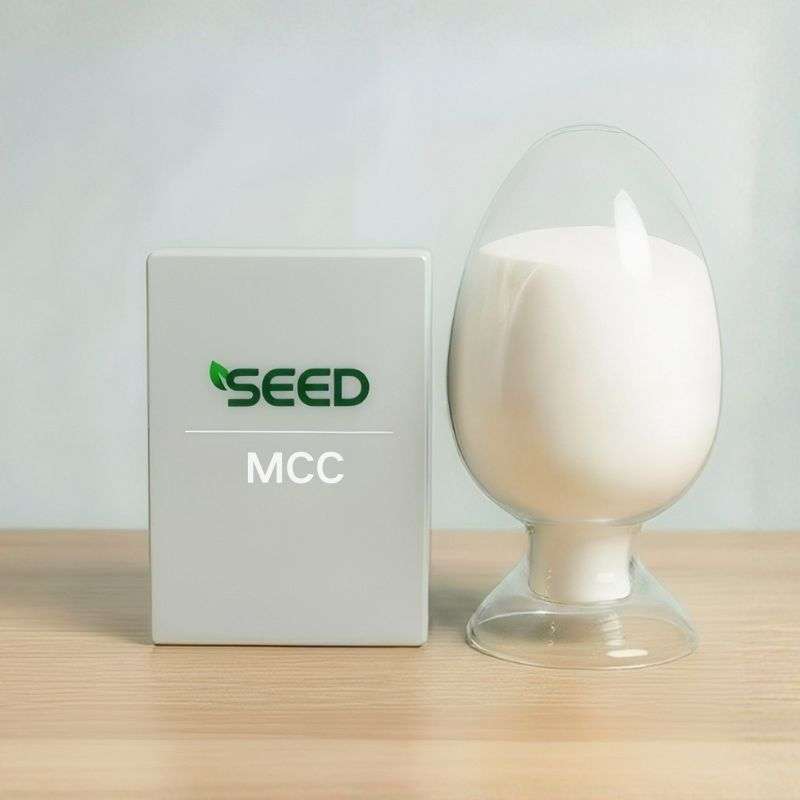
SEED MCC Product Details
MCC is a purified, partially depolymerized cellulose offering excellent binding, disintegration, and anti-caking properties. It serves as anti-caking agent in shredded cheese, fat replacer in reduced-calorie foods, texturizer in beverages, and provides dietary fiber benefits.
- Chemical Name: Microcrystalline Cellulose
- CAS Number: 9004-34-6
- Chemical Composition: Purified, partially depolymerized cellulose
- Appearance: White, odorless, tasteless, crystalline powder
- Bulk Density: 0.28-0.45 g/cm³ (varies by grade)
- Tapped Density: 0.35-0.55 g/cm³
- True Density: ~1.55 g/cm³
- pH Value: 5.0-7.5 (10% aqueous suspension)
- Moisture Content: ≤5.0%
- Loss on Drying: ≤7.0%
- Crystallinity: 55-80% (crystalline regions)
SEED MCC Product Parameters
MCC Particle Size Distribution:
Fine powders: 50-100 μm average
Granular: 100-200 μm average
Coarse: 200+ μm average
MCC Available Grades:
Standard MCC: General-purpose grade
Colloidal MCC: Co-processed with CMC for gel formation (e.g., Avicel RC, CL grades)
Silicified MCC: Co-processed with silicon dioxide for improved flow
Food grade MCC: E460(i) compliant
MCC Solubility:
Insoluble in: Water, dilute acids, dilute alkalis, most organic solvents
Slightly soluble in: Concentrated alkali solutions
Forms stable aqueous suspensions/dispersions
Colloidal grades form thixotropic gels
Other:
Storage Conditions: Store in tightly closed containers in cool, dry place. Shelf life: 36-60 months when properly stored. Hygroscopic; protect from moisture.
Packaging: 20kg or 25kg multi-wall kraft paper bags.

SEED MCC Product Advantages
Particle Engineering
Available in multiple particle size distributions, fine powders for improved binding, granular for better flow, silicified for enhanced flow and reduced sticking, colloidal for gel formation.
No Residual Allergens
Highly purified, gluten-free, allergen-free, non-GMO options available, suitable for sensitive populations, vegan/vegetarian suitable.
Regulatory Acceptance
Globally accepted, extensive regulatory filing support data available, GRAS status for food, well-established safety profile, accepted in all major markets.



SEED MCC Frequently Asked Questions
How does Microcrystalline Cellulose function in cheese products?
Microcrystalline Cellulose serves as an effective anti-caking agent, texturizer, and fat replacer in various cheese applications, particularly in shredded cheese products and reduced-fat cheese formulations. In pre-shredded cheese, MCC coats individual cheese particles preventing them from sticking together and forming clumps during storage, maintaining free-flowing characteristics that consumers expect for convenient use in cooking and food preparation. The cellulose particles create physical barriers between cheese shreds, absorbing surface moisture that would otherwise cause adhesion while allowing the cheese to retain its natural flavor and melting properties. In reduced-fat and low-fat cheese products, MCC serves as a partial fat replacer, providing bulk, improving texture, and enhancing mouthfeel that would otherwise be lost when fat content is decreased to meet health-conscious consumer demands.
What role does Microcrystalline Cellulose play in beverage applications?
Microcrystalline Cellulose functions as a stabilizer, suspending agent, and texture modifier in beverage formulations, particularly in products containing insoluble particles, pulp, or requiring enhanced mouthfeel and body. In fruit-based beverages, smoothies, and juice drinks containing pulp or fruit particles, MCC creates a stable suspension network that prevents settling and separation, maintaining uniform distribution of solids throughout the product’s shelf life without affecting clarity in translucent formulations or color in opaque products. MCC contributes insoluble dietary fiber to beverages, supporting nutritional claims and adding health benefits without impacting taste, which is increasingly important as consumers seek functional foods and drinks.
How is Microcrystalline Cellulose used in leather manufacturing and finishing?
Microcrystalline Cellulose serves important functions in leather processing and finishing operations, primarily as a coating additive, filler, and texture-enhancing agent that improves both leather appearance and performance characteristics. In leather finishing formulations, MCC acts as a matting agent creating desired matte or semi-matte surface finishes rather than high gloss, which is popular in casual footwear, upholstery, and fashion leather goods where natural, sophisticated appearance is preferred over shiny, plastic-like finishes. The cellulose particles provide excellent opacity and coverage in pigmented leather finishes, helping mask underlying color variations and surface imperfections while reducing the amount of expensive pigments required. MCC improves the physical properties of finish coatings including abrasion resistance, flexibility, and durability, helping leather withstand wear during use.
What advantages does Microcrystalline Cellulose offer as an anti-caking agent?
Microcrystalline Cellulose excels as an anti-caking agent across food and industrial applications due to its unique particle structure, high surface area, and excellent moisture absorption capacity that prevent powder agglomeration and clumping. The highly porous, crystalline structure of MCC provides exceptional moisture-absorbing capability, drawing away surface moisture from food particles or powder ingredients that would otherwise cause particles to stick together, cake, or form hard lumps during storage and handling. Unlike some anti-caking agents that can affect taste or require high usage levels, MCC functions effectively at low concentrations, typically between one and three percent, while remaining completely tasteless and odorless, making it ideal for food applications where flavor integrity is critical. In shredded cheese, grated parmesan, seasoning blends, powdered supplements, and other free-flowing food products, MCC maintains flowability, pourability, and ease of dispensing throughout the product’s shelf life.
How does Microcrystalline Cellulose contribute to reduced-fat and low-calorie food formulations?
Microcrystalline Cellulose plays a crucial role in reduced-fat and low-calorie food formulations as a fat replacer and bulking agent that helps maintain texture, mouthfeel, and consumer acceptance when fat or sugar content is reduced for healthier product profiles. When fat is removed from food products like cheese, dairy desserts, dressings, baked goods, and processed meats, significant texture, creaminess, and mouthfeel are lost, often making reduced-fat versions unpalatable to consumers accustomed to full-fat products. MCC compensates for these losses by providing bulk, body, and smooth texture that mimics some of fat’s sensory properties without contributing calories, since cellulose is indigestible and passes through the digestive system as dietary fiber.
What makes Microcrystalline Cellulose suitable for clean label food formulations?
Microcrystalline Cellulose is increasingly valued in clean label food formulations because it meets consumer demand for simple, natural, recognizable ingredients while providing essential functional properties previously delivered by synthetic additives. MCC is derived from purified cellulose obtained from wood pulp through controlled hydrolysis that breaks down cellulose chains to crystalline regions, creating a natural ingredient that consumers can understand and accept rather than complex chemical names that raise concerns. The ingredient appears on labels simply as “cellulose” or “microcrystalline cellulose,” which consumers recognize as plant fiber rather than artificial additives, supporting brand transparency and trust. MCC is non-GMO, free from major allergens including gluten, dairy, soy, and nuts, suitable for vegetarian, vegan, kosher, and halal dietary requirements, and biodegradable with minimal environmental impact. It provides multiple functional benefits including anti-caking, texturizing, fat replacement, and fiber fortification, allowing manufacturers to replace several synthetic ingredients with one natural multifunctional ingredient, simplifying formulations and ingredient lists.
Products you may be interested in



Connect with Us Today
Reach out to discover how our cellulose ether products can elevate your business and meet all your chemical solution needs.