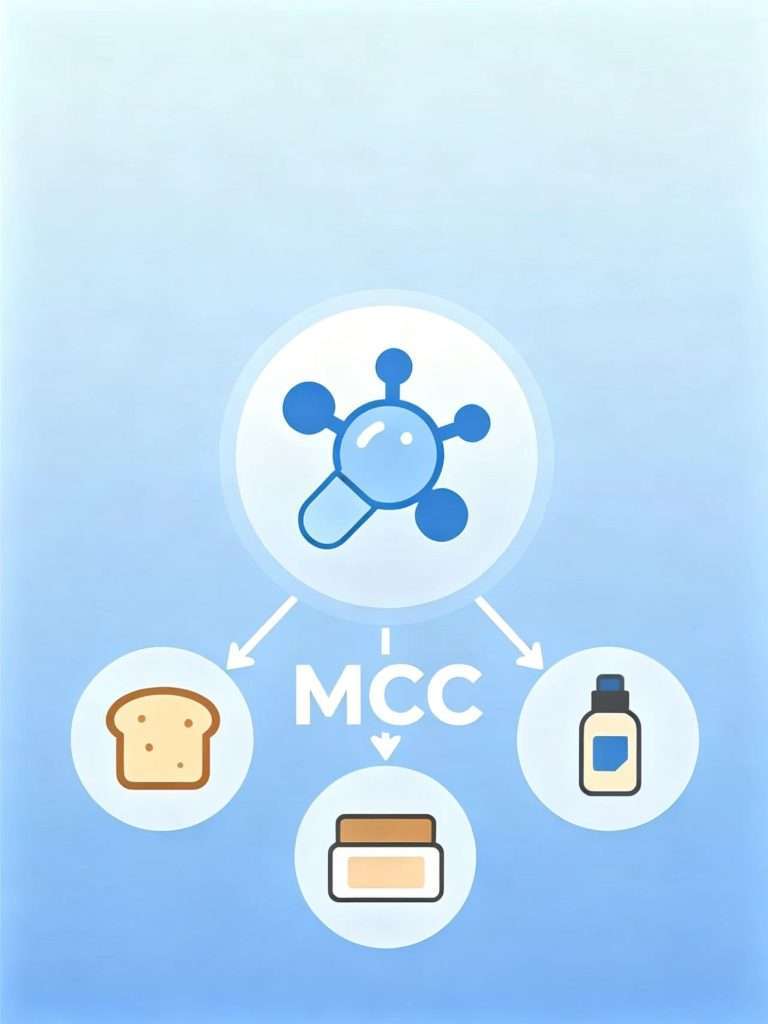
Microcrystalline Cellulose (abbreviated as MCC) is an odorless, tasteless white crystalline powder produced by subjecting natural cellulose to dilute acid hydrolysis until it reaches the limiting degree of polymerization. As a natural polysaccharide macromolecule, it features excellent biocompatibility, distinctive physicochemical properties and multifunctional performance. It has become an indispensable core excipient and raw material in pharmaceuticals, food, cosmetics, bioengineering and other industries.
Fundamental Properties and Structural Characteristics
MCC consists mainly of linear polysaccharide molecules linked by β-1,4-glucosidic bonds. Natural plant cellulose contains approximately 70% crystalline microcellulose and 30% amorphous regions. Hydrolysis removes the amorphous fractions, leaving highly crystalline microcrystalline segments intact.
- Appearance: White or off-white fine crystalline powder with particle sizes generally ranging from 20 to 80 μm, featuring tiny short rod-like or porous microstructures.
- Solubility: Insoluble in water, dilute acids, dilute alkalis and most organic solvents; partially soluble or swellable in dilute alkaline solutions.
- Physical Parameters: True density: 1.512–1.668 g/cm³; bulk density: approx. 0.337 g/cm³. Its Limiting Degree of Polymerization (LODP) typically falls between 15 and 375, with crystallinity generally above 60%.
- Stability: Stable under normal temperature and atmospheric pressure. It possesses strong hygroscopicity, capable of absorbing water equivalent to 2–3 times its own weight and swelling significantly. It exhibits strong resistance to light, heat, acids, alkalis and other environmental stressors.
Manufacturing Processes
Globally, MCC is predominantly manufactured from natural cellulose feedstocks including cotton linters, wood pulp, rice husks, hemp stalks, bagasse and more. Major production technologies are listed below:
1.Acid Hydrolysis Method
The most widely adopted and mature industrial process. Purified cellulose is hydrolyzed with mineral acids such as hydrochloric acid, sulfuric acid or nitric acid to break molecular chains within amorphous zones, followed by washing, drying and milling to obtain finished MCC. This process delivers short production cycles and high yields; precise control of acid concentration, temperature and reaction time is required to regulate particle size and polymerization degree.
2.Enzymatic Hydrolysis Method
Cellulase enzymes are applied to selectively hydrolyze the amorphous domains of cellulose. This technology operates under mild conditions with low energy consumption and eco-friendly workflows, yet suffers from high production costs and relatively low efficiency, limiting its current use to high-end specialized applications.
3.Emerging Advanced Technologies
Deep eutectic solvent (DES) treatment combined with ball milling enables efficient MCC fabrication under mild conditions. It boasts environmental sustainability and recyclable solvents, representing a key developmental direction for the industry in the future.
Core Application Sectors
Pharmaceutical Industry: The Cornerstone of Tablet Excipients
Known as the “universal excipient” in pharmaceutical manufacturing, MCC serves multiple critical functions:
- Filler: Excellent flowability and compactibility make it ideal for increasing the volume of tablets and capsules to facilitate accurate dosing and packaging.
- Disintegrant: Its unique capillary structure absorbs water and swells rapidly, disrupting internal bonding within tablets to accelerate disintegration in the gastrointestinal tract and boost drug bioavailability. For instance, MCC enables rifampicin tablets to disintegrate into fine mist within 1 minute.
- Binder: Intermolecular hydrogen bonds form under compression to deliver outstanding powder compactibility, enabling direct compression without conventional granulation. It effectively eliminates sticking issues and improves tablet hardness.
- Sustained-release Carrier: Active pharmaceutical ingredients are entrapped within its porous matrix. Slow swelling triggered by water diffusion achieves controlled, prolonged drug release.
Food Industry: Dual Enhancement of Nutrition and Texture
MCC is recognized as a safe food additive complying with the GRAS standard, certified jointly by the Food and Agriculture Organization (FAO) and the World Health Organization (WHO).
Dietary Fiber Supplement: As indigestible dietary fiber, it stimulates intestinal peristalsis, increases stool bulk to relieve constipation, generates satiety for weight management, and contributes zero calories.
- Stabilizer & Emulsifier: It forms crosslinked network structures in dairy beverages, sauces and suspensions to suspend fine particles, prevent phase separation and sedimentation, and extend shelf life.
- Texture Modifier: In frozen desserts such as ice cream, it restrains ice crystal formation, stabilizes foams and emulsions, and optimizes mouthfeel. It retains structural stability during high-temperature processing and partially replaces fat. A typical dosage is approximately 40 g/kg in ice cream formulations.
Cosmetics and Bioengineering
- Cosmetics: Acts as thickener, suspending agent and emulsion stabilizer in lotions, creams and facial masks. It improves product stability and sensory texture while boosting skin absorption of active ingredients.
- Bioengineering: Benefiting from superior biocompatibility, MCC functions as a scaffold material for tissue engineering and cell culture to promote cell adhesion and proliferation, supporting the construction of carriers for biomaterials.
Conclusion
As a high-performance biomass material derived from natural sources, microcrystalline cellulose (MCC) occupies a vital position in modern industries thanks to its multifunctional properties and safety profile. With advances in preparation technologies and in-depth applied research, its potential in precision medicine, functional food and eco-friendly materials will be further unlocked, heralding broad market prospects.