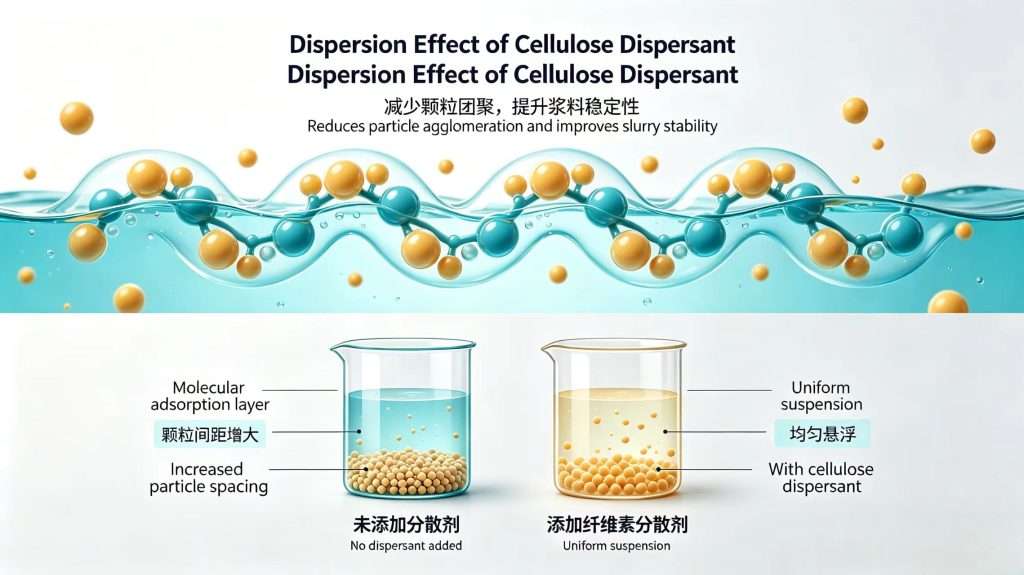
Cellulose dispersant,works by in the production of water-based formulations, pigments, dyes, powders and mineral particles tend to agglomerate easily and cause sedimentation and phase separation during storage. Conventional small-molecule dispersants suffer from drawbacks including high irritation, poor salt resistance and failure to meet environmental standards. Various cellulose derivatives modified from natural cotton and wood pulp have become mainstream eco-friendly bio-based dispersion stabilizers by virtue of their three-dimensional network colloidal structure combining steric hindrance and electrostatic repulsion
First of all Two Core Mechanisms of Cellulose as Dispersant
1. Steric Hindrance Isolation (Core Dispersing Capacity)
Cellulose molecular chains fully stretch in water, adsorb and encapsulate solid particles such as titanium dioxide, dyes, graphite and protein. A polymer protective layer is formed on the surface of particles to physically separate powders and prevent mutual adsorption and agglomeration, fundamentally solving caking and sedimentation of slurries.
2. Furthermore Three-Dimensional Network Colloidal Suspension Stabilization
A reversible thixotropic network structure is formed after hydration. It flows and disperses under slight shear, while the network locks fine particles at rest, balancing processing fluidity and long-term storage stability. Ionic CMC carries additional negative charges to generate electrostatic repulsion, greatly improving the dispersing performance in high-salt systems.
on the other hand Comparison of Dispersing Performance of 5 Common Cellulose Grades
1.For example CMCC Colloidal Microcrystalline Cellulose (Compound of MCC & CMC, Optimal Comprehensive Dispersibility)
- It can be used as the primary dispersion stabilizer and is the top choice for all industries.
- Pure standard MCC is insoluble in water and only swells after absorbing water. Modified via co-processing compounding, CMCC forms a nano microfibril network after hydration, with dual functions of physical isolation and weak electrostatic dispersion.
- Advantages: Salt, acid and alkali resistance; no phase separation in transparent systems, no gel fish eyes, fine powder dispersion without gritty texture
- Disadvantages: No dispersing effect in pure oil solvent systems; only compatible with fully water-based formulas
- Applications: High-end beverages, pharmaceutical suspensions, water-based color pastes, textile printing pastes
2.CMC Sodium Carboxymethyl Cellulose (Anionic Type with High-Charge Dispersion)
- The primary dispersant for industrial high-salt systems with outstanding cost performance.
- It is the only ionic cellulose, containing abundant negatively charged groups on molecular chains with strong electrostatic repulsion, delivering excellent dispersing performance for dyes and inorganic fillers.
- Advantages: Low cost, fast dissolution, good fluidity of low-viscosity grades, suitable for large-tonnage industrial slurries
- Disadvantages: Viscosity drops sharply in strongly alkaline environments; poor tolerance to high concentrations of calcium and magnesium ions
- Applications: Textile printing, ceramic glazes, lithium battery anode slurries, laundry detergents, underlayer dispersion for coatings
3.HMHEC Associative Hydroxyethyl Cellulose (Hydrophobically Modified HEC)
- Special rheological dispersant for coatings and premium personal care products
- With a dual structure of hydrophilic main chains and hydrophobic alkyl side chains, it disperses pigments, silicone oils and greases while resisting splashing and sagging.
- Advantages: Resistant to surfactants, stable across a wide pH range, improves water resistance of paint films and prevents sedimentation during storage
- Disadvantages: Its single dispersing capacity is inferior to CMC and CMCC; it acts more as an integrated additive combining dispersion, thickening and rheology modification
- Applications: Interior and exterior latex paints, water-based wood coatings, sulfate-free premium hair & body care products
4.Conventional HEC Hydroxyethyl Cellulose (Non-Ionic General Thickening & Dispersing Additive)
- Basic non-ionic cellulose where dispersion is only an auxiliary function; its core functions are thickening and water retention. It only provides mild auxiliary suspension and cannot break up agglomerated powders alone, so it must be compounded with anionic dispersants.
5.Pure MCC Microcrystalline Cellulose (Cannot Be Used as a Standalone Primary Dispersant)
- Pure MCC cannot dissolve in water and only serves as an anti-caking carrier in dry powder systems. In water-based systems, it merely suspends pre-dispersed particles without the ability to break powder agglomerates. It must be compounded with CMC to produce CMCC colloidal microcrystalline cellulose to achieve dispersing functions.