
Traditional nitrocellulose (NC) wood coatings have long dominated the finishing market for solid wood furniture, antique woodwork and musical instruments thanks to their fast drying speed, easy sanding property and excellent wood grain clarity. However, they have critical drawbacks: gradual yellowing during long-term service, poor UV resistance and weak chemical resistance, which make them unable to meet the stringent requirements for light-colored luxury wood panels, cabinets and outdoor wooden products. In addition, nitrocellulose suffers from persistent supply shortages and highly unstable stock availability.pushing formulators to turn to CAB cellulose and solid acrylic powder wood coating formulas as a reliable alternative
Nowadays, the mainstream upgrading solution in the coating industry adopts Cellulose Acetate Butyrate (CAB) combined with thermoplastic solid acrylic resin powder as the main film-forming binder to fully replace nitrocellulose systems. This combination retains the convenient workability of nitrocellulose varnishes, while delivering outstanding anti-yellowing performance, no intercoat lifting during recoating, great water and alcohol resistance, as well as long-term gloss and color retention. It has become the preferred formulation system for production lines of high-end wood coatings.
Functions and Selection Criteria for the Two Core Raw Materials
Cellulose Acetate Butyrate (CAB): System Performance Modifier (Key Additive & Auxiliary Film-Former)
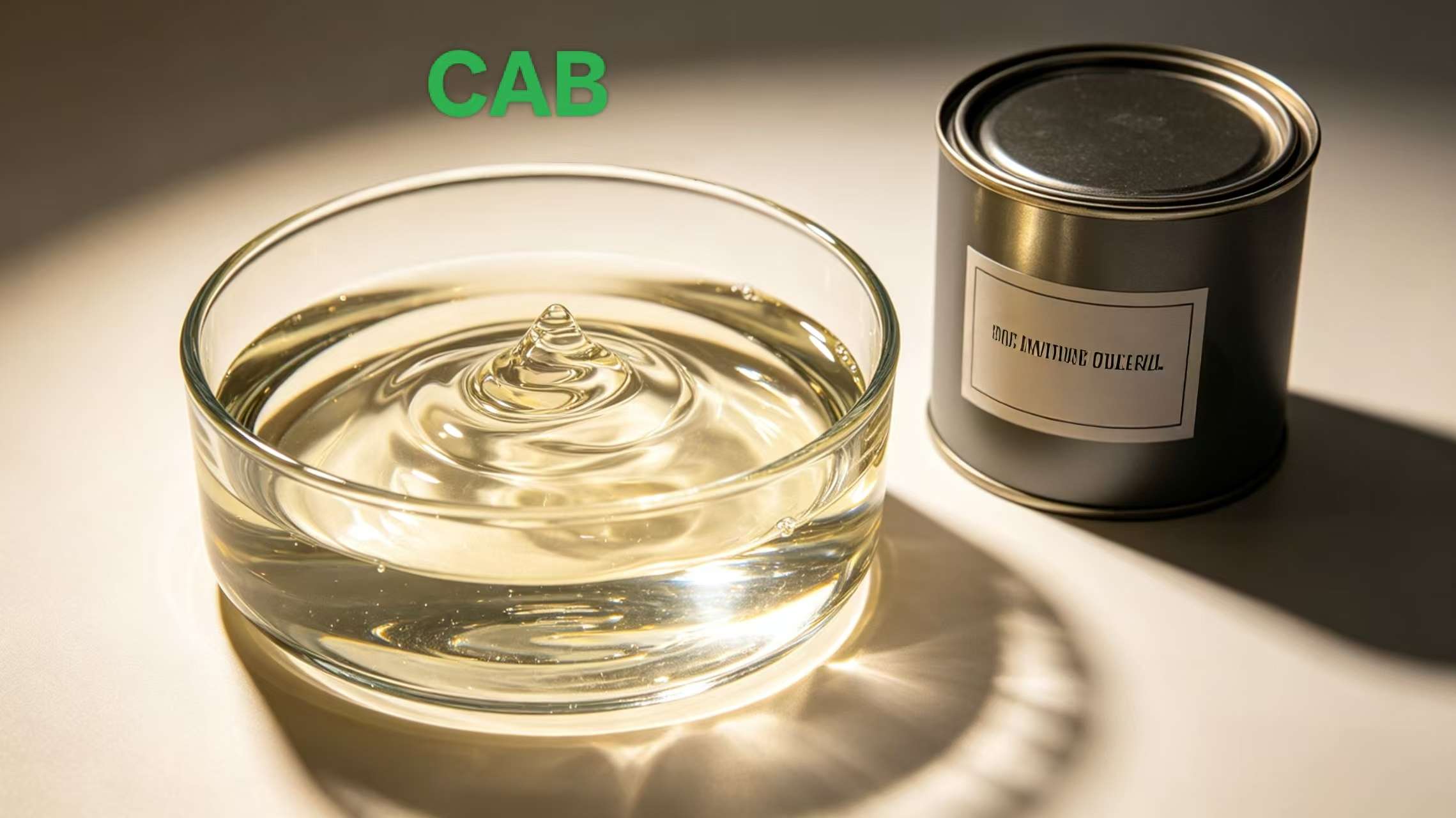
This CAB cellulose, paired with solid acrylic powder, forms the backbone of our high-performance wood coating system.CAB is a cellulose ester modified with a blend of acetic acid and butyric acid. With its unique molecular structure, it solves four common defects of pure acrylic wood coatings: poor leveling, slow drying, pigment bleeding during recoating and dull film appearance.
Grades widely used in the wood coating industry are listed below:
1.CAB-381-0.1 / CAB-381-0.5 (Low viscosity): Designed for topcoat high-gloss clear varnishes and automated spray lines. It releases solvent rapidly to avoid dust pick-up and delivers a moist, transparent finish. Recommended dosage: 3%~8%.
2.CAB-381-2 (Medium viscosity): Ideal for solid wood sealer primers and stain base coats to raise grain on pine and oak. It traps tannins and pigments to prevent lifting and color bleeding from topcoats. Recommended dosage: 5%~10%.
Key Benefits:
✅ Excellent UV stability with no yellowing during long-term indoor storage, perfect for light-colored timbers such as maple and birch
✅ Accelerates surface drying to a rate close to nitrocellulose coatings, greatly improving daily production capacity
✅ Creates a barrier layer to completely eliminate intercoat lifting and color bleeding of stains in re-coat applications
✅ Enhances surface smoothness and removes orange peel, pinholes and other surface imperfections
Solid Acrylic Resin Powder: Primary Film-Forming Component
To pair perfectly with CAB cellulose in our wood coating system,Only thermoplastic solid acrylic powder should be selected. It forms a film via solvent evaporation and air-dries at ambient temperature without baking. There are two major application systems:
1K Air-Dry System (First choice for mass production in furniture factories)
Recommended grades: SD-A-01C,SD-A58,SD-A66,SD-A73,SD-A200
Advantages: No curing agent required, no waste caused by pot life limitation. Compatible with spray, wipe and brush application with outstanding sandability.
Proven Practical Reference Formulations (Parts by Weight, Solvent-Borne Clear Varnish)
Formula 1: 1K Ambient Air-Dry Matte Topcoat for Furniture (CAB & Solid Acrylic System)
1. Thermoplastic solid acrylic powder: 40 parts
2. Pre-prepared 20% CAB stock solution: 22 parts (equivalent to 4.4 parts pure CAB)
3. Environment-friendly plasticizer (Tributyl Citrate): 2 parts, used to reduce film brittleness and avoid edge cracking
4. Additives: 0.2 parts silicone leveling agent + 0.2 parts defoamer + 3 parts matting powder OK520
5. Make up to 100 parts with mixed solvent: 50% Butyl Acetate + 30% MIBK + 20% Xylene
Formula 2: Sealer Primer (Prevent Grain Raising & Color Bleeding for Pine, Oak and Poplar)
1. Solid acrylic powder: 32 parts
2. 20% CAB-381-2 stock solution: 38 parts
3. Minor amounts of wetting agent and defoamer
4. Make up to 100 parts with blended slow-evaporating and fast-evaporating solvents
Critical Production Process (Avoid Whitening, Agglomeration and Delamination)
Do not mix the two kinds of powder and feed them together. Stepwise dissolution is the key to good compatibility:
1. Prepare CAB stock solution in advance (mandatory step)
Mix ratio: CAB powder : blended ketone-ester solvent = 1 : 4. Sprinkle the powder slowly under low-speed stirring to avoid lumps. Keep stirring at room temperature for 90~120 minutes until fully transparent. High-temperature heating is forbidden.
2. Dissolve solid acrylic resin separately
Add the remaining solvent into the dispersion tank, slowly add acrylic powder under medium-speed stirring, and keep stirring for 60~90 minutes until fully transparent with no particles.
3. Blend in fixed sequence (must not be reversed)
Add all additives into the acrylic solution and disperse at high speed for 15 minutes → reduce stirring speed and slowly pour in the CAB stock solution → finally add the plasticizer and stir gently for 5 minutes before discharging.